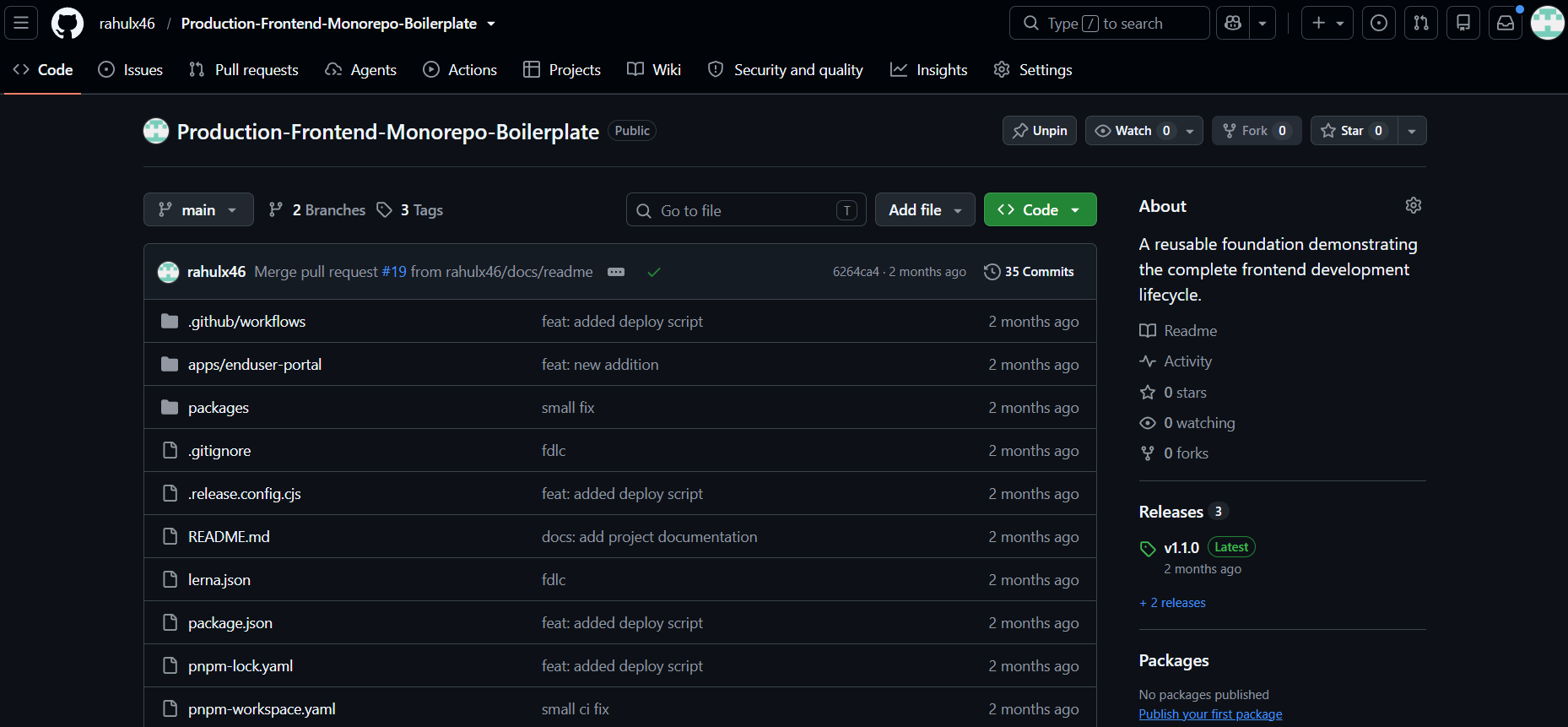
Production Frontend Monorepo Boilerplate
GitHub ↗About
Frontend Lifecycle is a modern React monorepo demonstrating how a frontend application moves from development to production using a scalable project structure, shared packages, automated quality checks, CI/CD pipelines, semantic versioning, and AWS deployment.
The purpose of this project is to demonstrate a production-ready frontend workflow rather than just a standalone React application.
Overview
This project explores the complete lifecycle of a frontend application:
Development │ ▼ Monorepo Architecture │ ▼ Shared Packages │ ▼ Type Checking │ ▼ Linting │ ▼ Unit Testing │ ▼ GitHub Actions │ ▼ SonarCloud Analysis │ ▼ Semantic Release │ ▼ AWS S3 Deployment │ ▼ CloudFront CDN
Project Structure
. ├── apps/ │ └── enduser-portal │ ├── packages/ │ ├── ui │ ├── eslint-config │ ├── jest-config │ └── typescript-config │ ├── .github/ │ └── workflows/ │ ├── pnpm-workspace.yaml ├── lerna.json ├── sonar-project.properties └── package.json
Technologies Used
Frontend
- React
- TypeScript
- Vite
Monorepo
- pnpm Workspaces
- Lerna
Code Quality
- ESLint
- TypeScript
- SonarCloud
Testing
- Jest
- React Testing Library
CI/CD
- GitHub Actions
- Semantic Release
Deployment
- AWS S3
- AWS CloudFront
- Origin Access Control (OAC)
Monorepo Architecture
The repository is organized using pnpm workspaces and Lerna.
Instead of placing everything inside a single React application, common functionality is extracted into reusable packages.
Examples include:
- Shared UI components
- Shared ESLint configuration
- Shared Jest configuration
- Shared TypeScript configuration
This approach keeps multiple applications consistent while avoiding duplicated configuration.
Shared Packages
The packages/ directory contains reusable modules shared across applications.
UI
Contains reusable React components that can be shared across applications.
ESLint Configuration
Provides shared linting rules so applications follow consistent coding standards.
Jest Configuration
Provides shared testing configuration.
TypeScript Configuration
Provides reusable TypeScript configuration that applications can extend instead of maintaining independent configurations.
Type Safety
A base TypeScript configuration is shared across the repository.
Each application extends the base configuration instead of maintaining its own independent setup.
Benefits include:
- Consistent compiler settings
- Reusable configuration
- Easier maintenance
Code Quality
ESLint is configured once and shared across all workspaces.
This ensures every project follows the same coding standards.
Testing
Unit testing is configured using:
- Jest
- React Testing Library
The repository includes sample tests and coverage generation to validate application behavior during CI.
Continuous Integration
GitHub Actions automatically validates every Pull Request.
Quality gates include:
- TypeScript compilation
- ESLint
- Unit Tests
- Production Build
- SonarCloud Analysis
The workflow ensures that code passes the required quality checks before it can be merged.
SonarCloud
Static code analysis is integrated using SonarCloud.
The analysis provides:
- Code smells
- Bugs
- Security hotspots
- Maintainability metrics
- Quality Gate validation
Semantic Release
Releases are automated using Semantic Release.
The workflow:
- Analyzes commit messages
- Determines the next version
- Generates release notes
- Publishes GitHub releases automatically
Deployment
Production builds are deployed automatically.
The deployment flow is:
GitHub │ ▼ GitHub Actions │ ▼ Production Build │ ▼ AWS S3 │ ▼ CloudFront │ ▼ End Users
The application is hosted using:
- Amazon S3
- CloudFront CDN
- Origin Access Control (OAC)
The S3 bucket remains private while CloudFront securely serves the application.
CI/CD Workflows
The repository contains multiple GitHub Actions workflows.
Pull Request
Runs quality checks for incoming pull requests.
Quality Gates
Executes:
- TypeScript
- ESLint
- Unit Tests
- Build
- SonarCloud
Release
Handles:
- Semantic Versioning
- GitHub Releases
Deploy
Deploys the production build to AWS.
Key Learnings
Working on this repository helped me understand:
- Monorepo architecture
- Workspace management
- Shared package design
- Reusable configurations
- GitHub Actions
- CI/CD pipelines
- Branch protection workflows
- Automated testing
- Static code analysis
- Semantic Versioning
- Production deployment
- AWS S3
- CloudFront
- Origin Access Control (OAC)
Future Improvements
- Add additional applications to the monorepo
- Expand shared UI components
- Increase unit test coverage
- Add end-to-end testing
- Automate infrastructure provisioning
- Add monitoring and performance reporting